
An intact acoustic organ and hearing function is of vital importance for natural flight animals like horses. Not diagnosed diseases of the ear and the lack of or reduced hearing may impact the wellbeing and performance of horses. Monica Alemán, Peter Scheifele, Gerald Schusser and Inge Wijnberg describe and discuss how to examine the ear, evaluate the hearing, avoid, treat and manage otological disorders of horses. All this information can be obtained by viewing and listening to the following three recordings.
The contents of the recordings are:
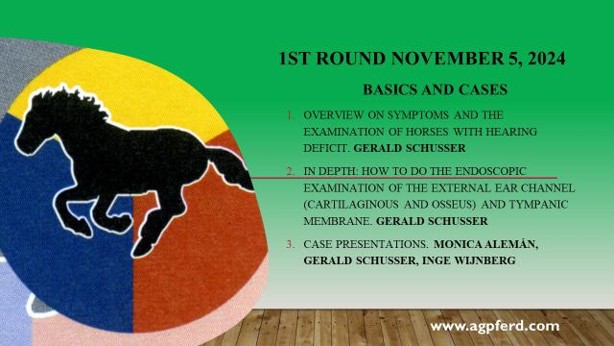
1st Round: 3:24 hours
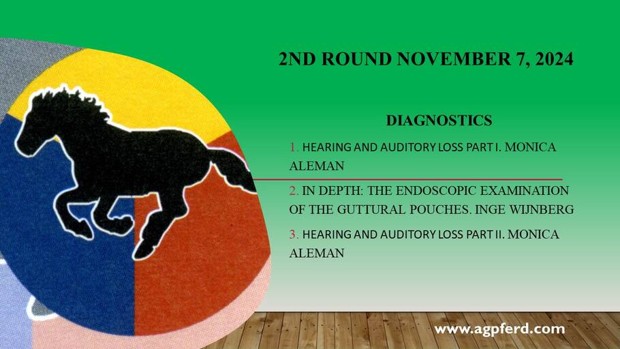
2nd Round: 3:26 hours
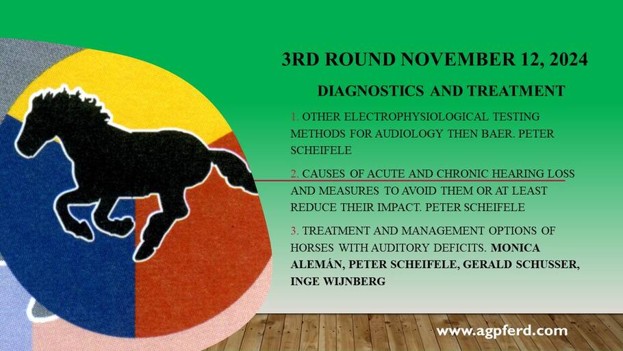
3rd Round: 3:24 hours
Speakers
Monica Aleman
obtained her veterinary degree at the University UNAM-Mexico. She completed residencies in large animal internal medicine (equine emphasis) and neurology and neurosurgery at UC Davis and achieved board certification for both specialties by the American College of Veterinary Internal Medicine. She completed a PhD in comparative pathology of neuromuscular diseases at UC Davis. Her research and clinical interest has focused in neurology, neuromuscular and muscle disorders in all species with equine emphasis. Currently, she is a faculty member of the equine internal medicine and neurology services, and Director of the Neuromuscular Disease Laboratory at UC Davis. Monica is one of the founding members of the Equine and Comparative Neurology Research Group, and is affiliated with the Clinical Neurophysiology Laboratory at UC Davis. Currently, she works in the investigation of neuromuscular disorders in multiple species including humans.
Peter Scheifele
is a Navy Vietnam and Cold War era veteran; submarine sonar and weapons officer/Navy Diver and Naval Oceanographer. He directed the Navy Marine Mammal Technology Program at the Naval Underwater Systems Center, specializing in marine mammal bioacoustics research and was Head Trainer at Mystic Aquarium. He was awarded the Order of the Decibel and a presidential citation by President George Bush Sr. for his pioneering work with marine mammal bioacoustics. He trained and handled narcotics and bomb dogs for the U.S. Coast Guard.
Presently, he directs the University of Cincinnati Facility for Education & Testing of Canine Hearing & the Laboratory for Animal Bioacoustic (FETCHLAB). This lab is world-renowned for investigating animal audiology, vocal mechanisms and bioacoustics and conducting animal audiology. He is Professor of animal bioacoustics, audiology, and human Neuroaudiology in the College of Allied Health Sciences, as well as otology and neurology in the College of Medicine. His degrees are in Physics, Acoustics, Speech/Hearing science and Neuroaudiology. The FETCHLAB is the first and only hearing (audiology) clinic for animals in the United States capable of running full audiological diagnostic testing and analyses. They see dogs and exotic animals from all over the world. They are responsible for noise impacts and animal audiology for the Georgia Aquarium, Mystic Aquarium, Newport Aquarium and the Indianapolis Zoo.
Gerald Schusser
studied veterinary medicine at the University of Vienna and conducted research under the supervision of Nathaniel White on the „Quantitative and Qualitative Analysis of the Myenteric Plexus in Horses with Colic“ at Virginia Tech University, USA. From 1994 to March 2017 he was Director of the Medical Veterinary Clinic, Faculty of Veterinary Medicine, University of Leipzig, and taught the subjects „Internal Diseases of the Horse and Forensic Veterinary Medicine“.
Inge Wijnberg
graduated from the Veterinary faculty of Utrecht University in the Netherlands in 1990. During her study she received a doctorate certificate for the study period in the USA on radiology, anaesthesiology and Intensive Care in 1988. Since 2000she is registered as Specialist KnMvD Equine Internal Medicine. She became Assistant Professor Equine Internal Medicine at the University, Dept. of Equine Sciences, Utrecht University, in 2002 and since 2004 she is a Diplomate of the European College of Equine Internal Medicine. Her areas of expertise are cardiology, neuromuscular disorders/clinical neurophysiology and neonatal intensive care.